







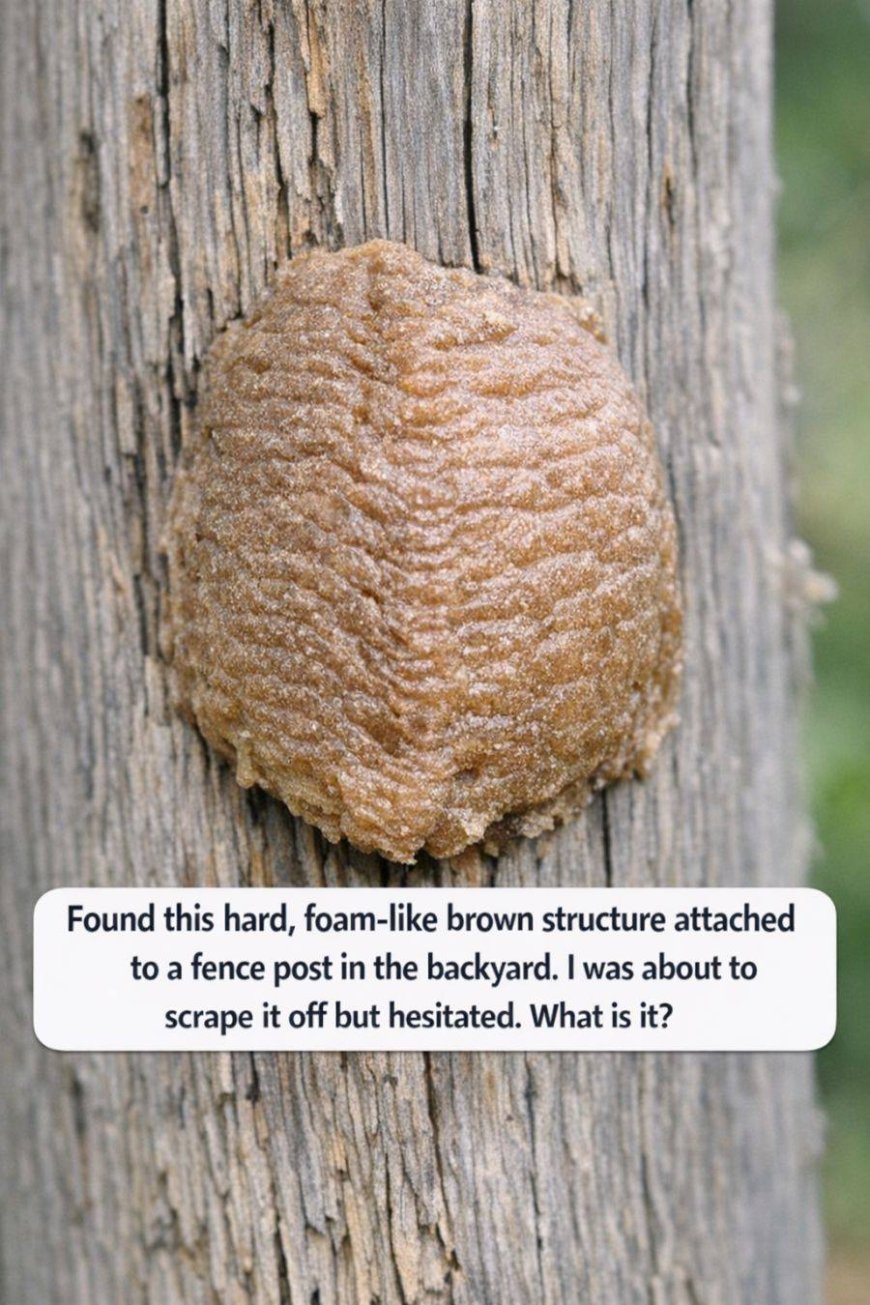
Found this hard, foam-like brown structure attached to a fence post in the backyard. I was about to scrape it off but hesitated. What is it?
Finding something strange in your backyard can be both intriguing and a little unsettling—especially when it looks hard, foamy, and completely out of place. At first glance, a brown, sponge-like mass attached to a fence post or branch might seem like old debris, fungus, or even the start of an insect nest you should remove right away. But sometimes, nature hides its most fascinating stories in the most unassuming forms.

1.
Found this hard, foam-like brown structure attached to a fence post in the backyard. I was about to scrape it off but hesitated. What is it?
You're absolutely right—and your thoughtful hesitation could mean you’ve just discovered one of nature’s most ingenious creations: a praying mantis egg case, or ootheca.
What You’ve Found: A Praying Mantis Ootheca
That hard, foam-like brown structure attached to your fence post is almost certainly the egg case of a praying mantis—not a wasp nest, fungus, or debris. And it’s far from ordinary.
Appearance: Tan to light brown, 1–2 inches long, with a rough, spongy, styrofoam-like texture.
Texture: Hard and brittle when dry, but originally secreted as a frothy liquid that hardens into a protective shell.
Location: Commonly found on twigs, stems, garden stakes, or wooden structures like fence posts—places sheltered from wind and rain.
Why It’s Remarkable (and Worth Protecting)
Inside that unassuming casing are 100–300 tiny mantis eggs, safely overwintering until spring. When temperatures warm (usually April–May, depending on your climate), the eggs will hatch into miniature mantises called nymphs, which scatter to hunt garden pests.
Praying mantises are beneficial predators—they eat aphids, mosquitoes, flies, caterpillars, and even stink bugs. One mantis can consume thousands of pests in its lifetime.
Don’t Scrape It Off! Here’s Why
You’d destroy hundreds of future pest controllers—free, chemical-free garden allies.
Mantises don’t harm plants, pets, or people—they’re harmless to humans and focused solely on insects.
They’re part of a healthy ecosystem—biodiversity starts with small wonders like this.
What to Do Instead
Leave it in place—it’s perfectly positioned by the mother mantis for optimal sun exposure and protection.
Mark the spot gently (e.g., tie a ribbon nearby) so you don’t accidentally disturb it during yard work.
Watch for hatching in spring—you might see a magical “cloud” of tiny nymphs emerging!
If the ootheca is on a branch you must prune, carefully relocate it to another sheltered spot (like a low tree limb or garden stake) using twine—don’t pierce or crush it.
How to Tell It Apart from a Wasp Nest
Feature
Praying Mantis Ootheca
Paper Wasp Nest
Shape
Solid, oblong foam
mass
Open honeycomb cells under a papery dome
Surface
Rough, bubbly, uniform
Smooth gray paper with visible holes
Activity
No insects coming/going (dormant in winter)
Wasps flying in/out (if active)
Tap the p.hoto to v.iew the full r.ecipe.